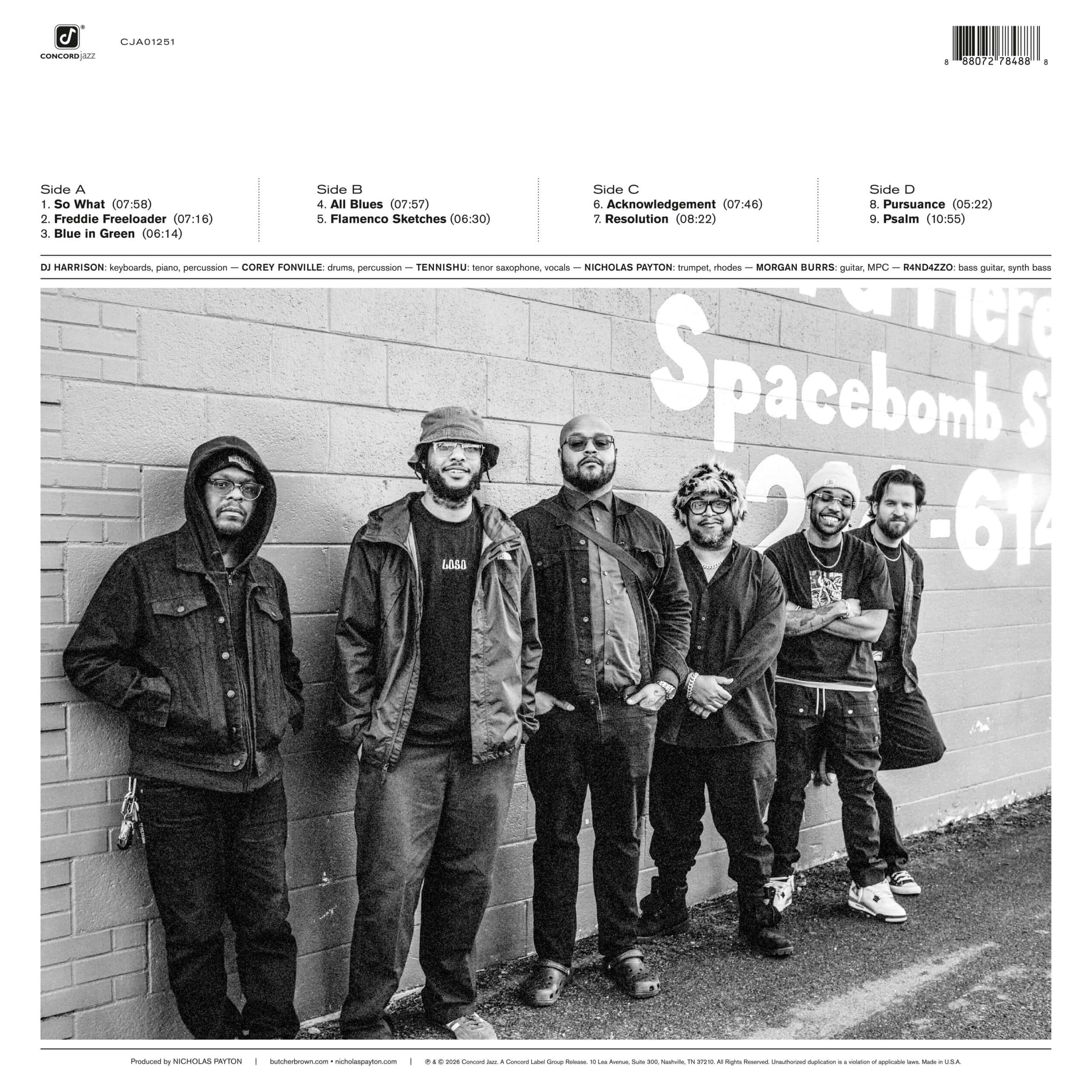
A Supreme Blue
Nicholas Payton, Butcher Brown
Bio
Artwork
Photos
Pack Shots
Videos
Press Release
Tour Dates

Liner Notes – A SUPREME BLUE – Ashley Kahn
Every music project is hatched somewhere—some location at some point in time. Like A Supreme Blue. And like many so many musical ideas, the idea worked itself up from the rhythm.
“Butcher Brown had a show and Nicholas came and sat in with us,” Corey Fonville recalls. “There was a song we were playing called ‘Unwind’ from Letters from The Atlantic with some kind of house-y groove and towards the middle of Nick’s solo he started quoting A Love Supreme.”
Nicholas Payton remembers the same moment. “Corey went into this House kind of groove. As they were vamping, I started hearing ‘Acknowledgement’ over it so I started playing the part Trane plays, taking the riff through different keys, and it became a real kind of vibe. Then someone posted a clip of it on Instagram and hashtagged it #AHouseSupreme. That’s how the idea started.”
“It definitely sparked interest because we sat on it for a little bit too,” Fonville adds. I mean it was fun. Then Nick immediately began to fixate on this idea. That same night after the gig, back at the hotel, he texted me extremely hyped. “Yo man, we gotta do a record.”
Fonville and Payton first met in 2010 when the young drummer from Virginia was still a student, working on his craft at the Brubeck Institute in California. The veteran New Orleans trumpeter was an instructor there, and picked up on Fonville’s acuity and confidence. “Corey was very talented, even then,” he remembers. “He had a great feel if he was swinging and, equally, if he was playing groove stuff. That was quite rare, especially at that time.”
Payton wasted no time grabbing Fonville and taking him on the road, while at the same time the drummer was thinking about bringing his mentor into his own situation back home. Payton recalls that “in that process, he kept telling me about his friend Devonne back in Richmond—DJ—and the group they had formed. He was sure we would vibe together.” Butcher Brown was that band, a lineup of university-trained, groove-oriented, hip-hop-leaning players who first came together in 2009 in Richmond’s vibrant music scene: producer / keyboardist DJ Harrison, trumpeter / saxophonist / MC Marcus “Tennishu” Tenney, guitarist Morgan Burrs, bassist Andrew Randazzo, and Fonville.
Fonville was right; Payton and the band clicked. He came to know the group in their early maturity, working with them on an early, unreleased album. A few years later, in 2014, Butcher played on his album Numbers, while Payton appeared on their first commercial release All Purpose Music. They’ve been keeping tabs on each other ever since, crossing paths and projects, in the studio and on stages—like the Boston gig in 2025 that led to this recording.
Payton admits there was a time when instinct would have steered him away from the idea of recording classics like Miles Davis’s Kind of Blue or John Coltrane’s A Love Supreme. But in 2014, he had the chance to perform Coltrane’s spiritual opus at San Francisco’s SFJAZZ with Ravi Coltrane, son of John and Alice Coltrane. “That was an eye-opener for me,” Payton says. “That helped open me up to the idea of exploring different treatments Our treatment of it was very electronic and with groove rhythms. Matt Garrison was on electric bass. For years I looked at A Love Supreme as untouchable, intangible, and that perhaps it should not be performed or recorded because it was such a spiritual endeavor and so sacred.”
The 2014 gig was to help celebrate the 50th anniversary of A Love Supreme. In 2026, the music world is focused on marking the centennials of both Miles Davis and John Coltrane, both born in 1926. “As I thought about this year, I thought it could work to do each of their best-known works and more importantly I think is how they both hit something in the culture,” Payton notes. “They still do.” He adds:
There’s a connection in Coltrane being on both, and musically, they both have the modal approach going on. Of course they also share a heavy spiritual component but also—especially with Miles—an African component. In his book, Miles spoke about coming off of the influence of the ‘Ballet Africaine’ [from Guinea] which was a show he saw and enjoyed the rhythm of the music, the thumb piano and especially the dancers. So there’s that too between Kind of Blue and A Love Supreme: the rhythmic nature of the Mozambique groove that goes into “Acknowledgement,” and Elvin [Jones]’s approach in general which was always coming out of an African conception. That was at the top of my mind with this project—creating these grooves and the whole rhythmic feel.
By the time of the unplanned encounter of “Acknowledgement” and a House groove, Payton did not need much of a push. “Corey is a huge fan of House, and Paul Stache at the club Smoke in New York City had been in my ear for a while about doing a House album, I thought it would be cool to do a House version of A Love Supreme.”
In fact, Payton and Butcher went into the studio with little more than a general idea. By plan, there was minimal preparation for the sessions, no rehearsals, and not much discussion. Payton acknowledges the leading role Fonville’s drum parts played in creating each of the tracks—”that part retains its integrity in our decision that it would be a dance record”—but in the recording process, “it very quickly became not just House. Like Miles says in the quote we sampled from a [1986] Dick Cavett interview on our version of ‘All Blues’: ‘When somebody gives you a concept, sometimes it isn’t like what you want it to do, and it comes out another way.’”
Payton believed in the music to find its way, as much as he counted on the members of Butcher Brown. “Nick trusted us enough that he felt he didn’t need to send us anything before,” Fonville says, describing Payton’s direction in the studio: “he leads by action for the most part. With Nick I could tell he was thinking, ‘We’re going to figure it out when we get in the room. They understand the assignment. I’m also going to try to approach this with an open mind and see what these cats bring to the table.’”
Payton’s trust was well placed. The tracks came together one after another. If there was any plan, it was in the sequence of tunes—a number from Kind of Blue, then from A Love Supreme, then back to Miles. Ideas were free to flow from any player at any point. “It was very organic,” Fonville recalls.
Like how “Pursuance” came out. That one in particular is insane to me. That was an example of us being in the room, Andrew started playing this bass line, and we just started grooving out. Nicholas was like, “What’s that?” Alright cool. Roll the tape. Marcus hit the tenor, Morgan on guitar, and it had this darker element to it because there were no keyboards on it. It had a different feel. But we didn’t know that was going to happen a day before, or even 30 minutes before. “Resolution,” same thing. All the songs. I think we really found creative ways to make each of these songs fresh.
What seems remarkable—even to the players themselves—is not only how little verbal instruction or discussion took place, but how quietly and inevitably the music fell together. “If you had just been a fly on the wall in that studio, it was quiet the whole time,” Fonville remembers. “It was like working with a bunch of Ninjas in a room. Everybody knew how to move around in a way and stealth and whatever they gotta do. It felt like we were just chillin’ but we were getting stuff done.”
A noticeable feeling of restraint in the studio led to a revelation.
“I remember a recording session with Ben Wolfe,” Payton says. “He wanted us to play all in the same room without headphones, so we had to play low enough to be able to hear the bass which is usually the softest. It felt almost like we were holding back, walking on eggshells. But when we listened to the playback I was amazed at how full and robust everything sounded. It didn’t sound held back at all. It sounded every bit as powerful. I remember thinking, “Oh, that’s really the magic of how those classic albums sounded so good because they weren’t overplaying the equipment.” One thing in particular about Kind of Blue that I don’t think is talked about often is that it’s a very soft album. It doesn’t come across when you’re listening to it because it’s very intense energetically. But if you pay close attention they’re not playing loud.”
They didn’t have to. Both Kind of Blue and A Love Supreme profited from high-end studios and seasoned recording engineers doing their part to capture sounds and details, employing the best equipment—and the live room itself. No one had to strain, no one had to push. Both recordings were born at the height of the high-fidelity era. While formats and equipment have changed, the guiding role of those in the control room has not. Like its sources of inspiration, A Supreme Blue benefits from “having a really amazing engineer do the session and mix it,” Fonville says. Payton agrees.
Alex de Jong, our recording and mix engineer, was integral to the sound of the project. From the start of the first take, he was adding effects in real time that instantly added this dub sheen on what we were tracking. That’s usually the type of thing done in post-production, but he had this intuitive sense when to trigger effects, and it made quite an impact in how we played. We were listening back after the recording was complete, and Corey said “King Tubby would be proud.” I would agree with that.
Updating is far too limited a term to describe what Payton and Butcher have achieved. Working with the same explorative energy that defined those giants begins to describe it. “We’re still paying homage to Miles and Trane,” Fonville says. “I think they would have appreciated hearing their music in this way, and not hearing it still being played in the way they did it in 1959 or 1963. It’s 2026. This is fresh. This is an insane take on that.”
Black American music, like any other legacy-focused tradition, aims to balance respect for its heroes, uphold its saints, while allowing the music to find its own path forward. It’s not difficult to understand why Payton needed time to come around to the idea that even with the holiest of the holies, music is just music. And that music, no matter the message or purpose or historical weight it might carry, goes where it wants to go.
—Ashley Kahn, March 2026
Ashley Kahn is author of Kind of Blue: The Making of the Miles Davis Masterpiece and A Love Supreme: The Story of John Coltrane’s Signature Album
 (opens in a new tab)
 (opens in a new tab)
 (opens in a new tab)
 (opens in a new tab)
Album Announce - Download
Blue In Green - Download
Album Release - Download
Resolution - Download
June 29 — Montreal, QC | Le Festival International de Jazz de Montreal (*with Nicholas Payton)
August 14 — Sardinia, Italy | Time In Jazz (*with Nicholas Payton)